
Earth-Bench V2 benchmark leaderboard
Earth observation data analysis, from Earth-Bench V2. One of the three evaluations of the Spatial Agent Index, and so of the Agent tasks group of the Spatial Intelligence Index. The Earth-Bench V2 questions that need the model to look at a picture are on the Earth-Bench V2 images page.
Score
All
Earth-Bench V2 score
Share of tasks passed, 0 to 100 · Higher is better
How to read this chart
What this metric means. The share of tasks the entry passed, 0 to 100.
Data table: Earth-Bench V2 score


Open weights
Earth-Bench V2 score
Share of tasks passed, 0 to 100 · Higher is better
How to read this chart
What this metric means. The share of tasks the entry passed, 0 to 100.
Data table: Earth-Bench V2 score
All
Earth-Bench V2: score vs. cost per task
Earth-Bench V2 score against average cost per task (USD) · Higher and further left is better
- Most attractive quadrant
- Pareto line
How to read this chart
What cost is measuring. What one attempt at a task would cost if paid token by token at the provider's published API prices, averaged over attempts: ordinary input tokens, input tokens served from the provider's cache at the lower cached price, tokens written to the cache where the provider charges for that, and output tokens (thinking included). Cost assumes each harness uses the model's pay-per-token API, priced at public list rates; sandboxes and our own engineering time are not included. Failed attempts count too.
How to read this chart. Each point is one entry. Further left means a lower average cost per task (log scale); higher means a higher Earth-Bench V2 score. Both axes fit the points shown, so the score axis does not start at zero. The shaded most attractive quadrant is the top-left quarter of the plot, split at the middle of each axis: a reading aid, not a fixed bar. The dotted Pareto line joins the points that no cheaper one beats on score. Only exact costs are plotted; the table lists every entry.
Data table: Earth-Bench V2: score vs. cost per task
Open weights
Earth-Bench V2: score vs. cost per task
Earth-Bench V2 score against average cost per task (USD) · Higher and further left is better
- Most attractive quadrant
- Pareto line
How to read this chart
What cost is measuring. What one attempt at a task would cost if paid token by token at the provider's published API prices, averaged over attempts: ordinary input tokens, input tokens served from the provider's cache at the lower cached price, tokens written to the cache where the provider charges for that, and output tokens (thinking included). Cost assumes each harness uses the model's pay-per-token API, priced at public list rates; sandboxes and our own engineering time are not included. Failed attempts count too.
How to read this chart. Each point is one entry. Further left means a lower average cost per task (log scale); higher means a higher Earth-Bench V2 score. Both axes fit the points shown, so the score axis does not start at zero. The shaded most attractive quadrant is the top-left quarter of the plot, split at the middle of each axis: a reading aid, not a fixed bar. The dotted Pareto line joins the points that no cheaper one beats on score. Only exact costs are plotted; the table lists every entry.
Data table: Earth-Bench V2: score vs. cost per task
Token usage
All
Earth-Bench V2: tokens per task
Average tokens per task by type · Lower is better
- Uncached input
- Cached input
- Output (reasoning included)
How to read this chart
What the parts mean. Uncached input: input tokens read at the full price. Cached input: input tokens served from the provider's cache at the lower cached price. Output: the tokens the model wrote, its reasoning included, as reported by the provider.
Compare with care. Models use different tokenisers, so the same text is a different number of tokens for different models. Use token counts to see how much work each model did, and cost to compare spending.
Data table: Earth-Bench V2: tokens per task
Open weights
Earth-Bench V2: tokens per task
Average tokens per task by type · Lower is better
- Uncached input
- Cached input
- Output (reasoning included)
How to read this chart
What the parts mean. Uncached input: input tokens read at the full price. Cached input: input tokens served from the provider's cache at the lower cached price. Output: the tokens the model wrote, its reasoning included, as reported by the provider.
Compare with care. Models use different tokenisers, so the same text is a different number of tokens for different models. Use token counts to see how much work each model did, and cost to compare spending.
Data table: Earth-Bench V2: tokens per task
Cost
All
Earth-Bench V2: cost per task
Average cost per task (USD) by token type · Lower is better
- Uncached input
- Cached input
- Output
- Not split by token type
How to read this chart
What cost is measuring. What one attempt at a task would cost if paid token by token at the provider's published API prices, averaged over attempts: ordinary input tokens, input tokens served from the provider's cache at the lower cached price, tokens written to the cache where the provider charges for that, and output tokens (thinking included). Cost assumes each harness uses the model's pay-per-token API, priced at public list rates; sandboxes and our own engineering time are not included. Failed attempts count too.
How the cost is split. Each part is the entry's average tokens of that type times its list price. The rest, mostly tokens written to the cache, is shown as not split by token type.
Data table: Earth-Bench V2: cost per task
| Model | Developer | Uncached input | Cached input | Output | Not split by token type | Total |
|---|---|---|---|---|---|---|
| Qwen 3.6 35B-A3B (Reasoning), Qwen Code | Alibaba (Qwen) | No data | No data | No data | $0.00 | $0.00 |
| GPT-6 Luna (medium), Codex | OpenAI | $0.0013 | $0.00074 | $0.00079 | $0.00 | $0.0028 |
| GPT-6 Luna (low), Codex | OpenAI | $0.0017 | $0.0013 | $0.00093 | $0.00 | $0.0040 |
| GPT-6 Luna (high), Codex | OpenAI | $0.0018 | $0.00098 | $0.0018 | $0.00000029 | $0.0046 |
| Nemotron 3.5 Lightning 30B (Reasoning), Terminus-2 | NVIDIA | $0.0013 | $0.0027 | $0.0013 | $0.00000034 | $0.0053 |
| gpt-oss-120b (low), Terminus-2 | OpenAI | $0.0017 | $0.00 | $0.0012 | $0.0025 | $0.0054 |
| Claude Haiku 5.5 (low), Claude Code | Anthropic | $0.0011 | $0.0018 | $0.0019 | $0.0011 | $0.0060 |
| GPT-5.6 Luna (low), Codex | OpenAI | $0.0025 | $0.0015 | $0.0023 | $0.00 | $0.0062 |
| Claude Haiku 5.5 (medium), Claude Code | Anthropic | $0.0013 | $0.0020 | $0.0024 | $0.0013 | $0.0070 |
| Gemini 3.1 Flash-Lite (minimal), Terminus-2 | $0.0033 | $0.00025 | $0.0047 | $0.00000046 | $0.0082 | |
| GPT-6 Luna (xhigh), Codex | OpenAI | $0.0026 | $0.0016 | $0.0046 | $0.00 | $0.0087 |
| Claude Haiku 5.5 (high), Claude Code | Anthropic | $0.0017 | $0.0025 | $0.0041 | $0.0017 | $0.010 |
| GPT-5.6 Luna (medium), Codex | OpenAI | $0.0038 | $0.0024 | $0.0043 | $0.00000025 | $0.010 |
| Nemotron 3.5 Super VL 120B (Reasoning), Terminus-2 | NVIDIA | $0.0048 | $0.00073 | $0.0053 | $0.00000022 | $0.011 |
| Nemotron 3.5 Super 120B (Reasoning), Terminus-2 | NVIDIA | $0.0068 | $0.0016 | $0.0063 | $0.00 | $0.015 |
| MiniMax M3.1 Flash (max), Terminus-2 | MiniMax | $0.0029 | $0.0027 | $0.014 | $0.00000039 | $0.019 |
| gpt-oss-20b (high), Terminus-2 | OpenAI | $0.0028 | $0.00 | $0.012 | $0.0052 | $0.020 |
| Claude Haiku 5.5 (xhigh), Claude Code | Anthropic | $0.0031 | $0.0041 | $0.0094 | $0.0047 | $0.021 |
| Llama 3.3 70B (Non-reasoning), Terminus-2 | Meta | $0.018 | $0.00 | $0.0017 | $0.0016 | $0.021 |
| GPT-5.6 Luna (high), Codex | OpenAI | $0.0069 | $0.0060 | $0.010 | $0.00 | $0.023 |
| Gemini 3.1 Flash-Lite (low), Terminus-2 | $0.0058 | $0.0010 | $0.016 | $0.00000015 | $0.023 | |
| Gemma 4 31B (Reasoning), Terminus-2 | $0.016 | $0.0021 | $0.0047 | $0.00 | $0.023 | |
| Gemma 4 26B A4B (Reasoning), Terminus-2 | No data | No data | No data | $0.027 | $0.027 | |
| GPT-5.6 Luna (xhigh), Codex | OpenAI | $0.0079 | $0.010 | $0.015 | $0.00000015 | $0.033 |
| gpt-oss-120b (high), Terminus-2 | OpenAI | $0.010 | $0.00 | $0.0090 | $0.016 | $0.035 |
| Gemini 3.1 Flash-Lite (high), Terminus-2 | $0.0068 | $0.0014 | $0.035 | $0.000000030 | $0.043 | |
| GLM-4.7-Flash (Reasoning), Terminus-2 | Z.ai | No data | No data | No data | $0.047 | $0.047 |
| Mistral Large 3 (Non-reasoning), Terminus-2 | Mistral AI | $0.035 | $0.00 | $0.012 | $0.00000040 | $0.047 |
| Claude Sonnet 5.5 (low), Claude Code | Anthropic | $0.013 | $0.0077 | $0.014 | $0.013 | $0.048 |
| Claude Sonnet 5.5 (medium), Claude Code | Anthropic | $0.014 | $0.0085 | $0.018 | $0.014 | $0.054 |
| GPT-6.1 Sol (medium), Codex | OpenAI | $0.028 | $0.0091 | $0.019 | $0.00000061 | $0.056 |
| GPT-6.1 Sol (high), Codex | OpenAI | $0.033 | $0.011 | $0.029 | $0.00000077 | $0.072 |
| Laguna XS 2.1 (Reasoning), Terminus-2 | Poolside | $0.0099 | $0.057 | $0.0067 | $0.00 | $0.073 |
| Claude Sonnet 5.5 (high), Claude Code | Anthropic | $0.019 | $0.011 | $0.028 | $0.019 | $0.077 |
| MiMo V2.6 Flash (Reasoning), MiMo Code | Xiaomi | $0.059 | $0.0090 | $0.018 | $0.00 | $0.086 |
| Claude Opus 5.5 (low), Claude Code | Anthropic | $0.025 | $0.015 | $0.028 | $0.025 | $0.093 |
| GPT-6 Sol (high), Codex | OpenAI | $0.028 | $0.032 | $0.040 | $0.00000014 | $0.10 |
| gpt-oss-20b (high), Codex | OpenAI | $0.033 | $0.00 | $0.0094 | $0.061 | $0.10 |
| DeepSeek V4 Flash (max), Terminus-2 | DeepSeek | $0.010 | $0.0015 | $0.033 | $0.064 | $0.11 |
| GPT-6.1 Sol (xhigh), Codex | OpenAI | $0.043 | $0.015 | $0.051 | $0.00000019 | $0.11 |
| Muse Glimmer 30B (high), Terminus-2 | Meta | $0.070 | $0.013 | $0.029 | $0.000000048 | $0.11 |
| Mistral Large 4 (high), Terminus-2 | Mistral AI | $0.071 | $0.010 | $0.037 | $0.00 | $0.12 |
| GPT-5.6 Terra (high), Codex | OpenAI | $0.040 | $0.031 | $0.047 | $0.00 | $0.12 |
| Nemotron 3 Ultra (high), Terminus-2 | NVIDIA | $0.061 | $0.013 | $0.047 | $0.00 | $0.12 |
| DeepSeek V4.1 Flash (max), Codex | DeepSeek | $0.018 | $0.0056 | $0.042 | $0.066 | $0.13 |
| GLM-5.3-Flash (low), Terminus-2 | Z.ai | $0.096 | $0.021 | $0.016 | $0.00 | $0.13 |
| DeepSeek V4 Flash (high), Terminus-2 | DeepSeek | $0.015 | $0.0018 | $0.037 | $0.080 | $0.13 |
| Qwen 3.6 35B-A3B (Reasoning), Terminus-2 | Alibaba (Qwen) | $0.022 | $0.058 | $0.054 | $0.00000023 | $0.13 |
| Claude Haiku 4.5 (Reasoning), Claude Code | Anthropic | $0.020 | $0.037 | $0.058 | $0.020 | $0.14 |
| Qwen 3.8 27B (xhigh), Terminus-2 | Alibaba (Qwen) | No data | No data | No data | $0.14 | $0.14 |
| Claude Opus 5.5 (medium), Claude Code | Anthropic | $0.034 | $0.020 | $0.053 | $0.034 | $0.14 |
| Claude Haiku 5.5 (max), Claude Code | Anthropic | $0.0091 | $0.010 | $0.038 | $0.085 | $0.14 |
| GLM-5.2 (Non-reasoning), Terminus-2 | Z.ai | $0.041 | $0.072 | $0.039 | $0.00 | $0.15 |
| Claude Sonnet 5.5 (xhigh), Claude Code | Anthropic | $0.034 | $0.018 | $0.071 | $0.034 | $0.16 |
| DeepSeek V4 Flash (high), Claude Code | DeepSeek | $0.013 | $0.0028 | $0.022 | $0.13 | $0.17 |
| MiniMax M3 (Reasoning), MiniMax Code | MiniMax | $0.027 | $0.097 | $0.051 | $0.00 | $0.18 |
| Claude Opus 5.5 (high), Claude Code | Anthropic | $0.041 | $0.024 | $0.075 | $0.041 | $0.18 |
| DeepSeek V4 Flash (high), Codex | DeepSeek | $0.035 | $0.0066 | $0.024 | $0.12 | $0.19 |
| Step 5 Preview (Reasoning), Terminus-2 | StepFun | No data | No data | No data | $0.19 | $0.19 |
| Gemini 3.8 Flash (low), Terminus-2 | $0.11 | $0.033 | $0.053 | $0.000000035 | $0.20 | |
| GLM-5.3-Flash (max), Claude Code | Z.ai | $0.15 | $0.023 | $0.031 | $0.00 | $0.20 |
| Kimi K2.6 (Reasoning), Terminus-2 | Moonshot AI | $0.048 | $0.050 | $0.11 | $0.00000011 | $0.21 |
| GLM-5.3-Flash (max), Terminus-2 | Z.ai | $0.18 | $0.024 | $0.030 | $0.00000029 | $0.23 |
| Kimi K2.7 Code (Reasoning), Terminus-2 | Moonshot AI | $0.048 | $0.11 | $0.094 | $0.00 | $0.25 |
| GPT-5.6 Sol (high), Codex | OpenAI | $0.086 | $0.077 | $0.10 | $0.00 | $0.26 |
| Qwen 3.8 27B (Reasoning), Qwen Code | Alibaba (Qwen) | No data | No data | No data | $0.32 | $0.32 |
| Claude Sonnet 5 (high), Claude Code | Anthropic | $0.047 | $0.091 | $0.14 | $0.047 | $0.32 |
| Kimi K2.7 Code (Reasoning), Kimi Code | Moonshot AI | $0.069 | $0.21 | $0.098 | $0.00000016 | $0.38 |
| GLM-5.2 (high), Terminus-2 | Z.ai | $0.087 | $0.15 | $0.16 | $0.00 | $0.39 |
| Claude Opus 5.5 (xhigh), Claude Code | Anthropic | $0.079 | $0.042 | $0.20 | $0.079 | $0.40 |
| DeepSeek V4.1 Flash (max), Claude Code | DeepSeek | $0.019 | $0.0074 | $0.056 | $0.33 | $0.41 |
| Kimi K3 (Reasoning), Terminus-2 | Moonshot AI | $0.23 | $0.00 | $0.18 | $0.00 | $0.41 |
| Claude Opus 4.8 (high), Claude Code | Anthropic | $0.073 | $0.084 | $0.21 | $0.073 | $0.44 |
| Claude Fable 5.1 (medium), Claude Code | Anthropic | $0.12 | $0.028 | $0.19 | $0.11 | $0.44 |
| Claude Opus 5 (high), Claude Code | Anthropic | $0.087 | $0.097 | $0.21 | $0.087 | $0.48 |
| GLM-5.2 (max), Terminus-2 | Z.ai | $0.13 | $0.16 | $0.19 | $0.00 | $0.48 |
| GLM-5.2 (max), Claude Code | Z.ai | $0.19 | $0.16 | $0.21 | $0.00000019 | $0.56 |
| Kimi K3 (Reasoning), Kimi Code | Moonshot AI | $0.16 | $0.13 | $0.28 | $0.00000010 | $0.56 |
| DeepSeek V4 Pro (high), Terminus-2 | DeepSeek | $0.21 | $0.0028 | $0.071 | $0.28 | $0.57 |
| Claude Opus 4.7 (high), Claude Code | Anthropic | $0.093 | $0.17 | $0.22 | $0.093 | $0.58 |
| Kimi K2.6 (Reasoning), Kimi Code | Moonshot AI | $0.073 | $0.36 | $0.17 | $0.00000050 | $0.60 |
| GLM-5.3 (low), Terminus-2 | Z.ai | $0.50 | $0.036 | $0.084 | $0.00 | $0.62 |
| gpt-oss-120b (high), Codex | OpenAI | $0.26 | $0.00 | $0.040 | $0.35 | $0.65 |
| Claude Fable 5.1 (high), Claude Code | Anthropic | $0.17 | $0.042 | $0.33 | $0.17 | $0.71 |
| DeepSeek V4 Pro (max), Terminus-2 | DeepSeek | $0.29 | $0.0049 | $0.091 | $0.38 | $0.76 |
| GLM-5.3 (max), Terminus-2 | Z.ai | $0.64 | $0.036 | $0.15 | $0.00 | $0.83 |
| GLM-4.7-Flash (Reasoning), Claude Code | Z.ai | $0.12 | $0.00 | $0.0083 | $0.74 | $0.87 |
| GLM-5.3 (max), Claude Code | Z.ai | $0.74 | $0.084 | $0.15 | $0.00000057 | $0.98 |
| Claude Sonnet 5.5 (max), Claude Code | Anthropic | $0.24 | $0.15 | $0.90 | $0.28 | $1.57 |
| Claude Opus 5.5 (max), Claude Code | Anthropic | $0.28 | $0.16 | $0.96 | $0.27 | $1.67 |
| Nemotron 3 Nano Omni 30B (Reasoning), Terminus-2 | NVIDIA | No data | No data | No data | No data | No data |
| Nemotron 3.5 Bolt E4B (Reasoning), Terminus-2 | NVIDIA | No data | No data | No data | No data | No data |
Open weights
Earth-Bench V2: cost per task
Average cost per task (USD) by token type · Lower is better
- Uncached input
- Cached input
- Output
- Not split by token type
How to read this chart
What cost is measuring. What one attempt at a task would cost if paid token by token at the provider's published API prices, averaged over attempts: ordinary input tokens, input tokens served from the provider's cache at the lower cached price, tokens written to the cache where the provider charges for that, and output tokens (thinking included). Cost assumes each harness uses the model's pay-per-token API, priced at public list rates; sandboxes and our own engineering time are not included. Failed attempts count too.
How the cost is split. Each part is the entry's average tokens of that type times its list price. The rest, mostly tokens written to the cache, is shown as not split by token type.
Data table: Earth-Bench V2: cost per task
| Model | Developer | Uncached input | Cached input | Output | Not split by token type | Total |
|---|---|---|---|---|---|---|
| Qwen 3.6 35B-A3B (Reasoning), Qwen Code | Alibaba (Qwen) | No data | No data | No data | $0.00 | $0.00 |
| Nemotron 3.5 Lightning 30B (Reasoning), Terminus-2 | NVIDIA | $0.0013 | $0.0027 | $0.0013 | $0.00000034 | $0.0053 |
| gpt-oss-120b (low), Terminus-2 | OpenAI | $0.0017 | $0.00 | $0.0012 | $0.0025 | $0.0054 |
| Nemotron 3.5 Super VL 120B (Reasoning), Terminus-2 | NVIDIA | $0.0048 | $0.00073 | $0.0053 | $0.00000022 | $0.011 |
| Nemotron 3.5 Super 120B (Reasoning), Terminus-2 | NVIDIA | $0.0068 | $0.0016 | $0.0063 | $0.00 | $0.015 |
| MiniMax M3.1 Flash (max), Terminus-2 | MiniMax | $0.0029 | $0.0027 | $0.014 | $0.00000039 | $0.019 |
| gpt-oss-20b (high), Terminus-2 | OpenAI | $0.0028 | $0.00 | $0.012 | $0.0052 | $0.020 |
| Llama 3.3 70B (Non-reasoning), Terminus-2 | Meta | $0.018 | $0.00 | $0.0017 | $0.0016 | $0.021 |
| Gemma 4 31B (Reasoning), Terminus-2 | $0.016 | $0.0021 | $0.0047 | $0.00 | $0.023 | |
| Gemma 4 26B A4B (Reasoning), Terminus-2 | No data | No data | No data | $0.027 | $0.027 | |
| gpt-oss-120b (high), Terminus-2 | OpenAI | $0.010 | $0.00 | $0.0090 | $0.016 | $0.035 |
| GLM-4.7-Flash (Reasoning), Terminus-2 | Z.ai | No data | No data | No data | $0.047 | $0.047 |
| Mistral Large 3 (Non-reasoning), Terminus-2 | Mistral AI | $0.035 | $0.00 | $0.012 | $0.00000040 | $0.047 |
| Laguna XS 2.1 (Reasoning), Terminus-2 | Poolside | $0.0099 | $0.057 | $0.0067 | $0.00 | $0.073 |
| MiMo V2.6 Flash (Reasoning), MiMo Code | Xiaomi | $0.059 | $0.0090 | $0.018 | $0.00 | $0.086 |
| gpt-oss-20b (high), Codex | OpenAI | $0.033 | $0.00 | $0.0094 | $0.061 | $0.10 |
| DeepSeek V4 Flash (max), Terminus-2 | DeepSeek | $0.010 | $0.0015 | $0.033 | $0.064 | $0.11 |
| Muse Glimmer 30B (high), Terminus-2 | Meta | $0.070 | $0.013 | $0.029 | $0.000000048 | $0.11 |
| Mistral Large 4 (high), Terminus-2 | Mistral AI | $0.071 | $0.010 | $0.037 | $0.00 | $0.12 |
| Nemotron 3 Ultra (high), Terminus-2 | NVIDIA | $0.061 | $0.013 | $0.047 | $0.00 | $0.12 |
| DeepSeek V4.1 Flash (max), Codex | DeepSeek | $0.018 | $0.0056 | $0.042 | $0.066 | $0.13 |
| GLM-5.3-Flash (low), Terminus-2 | Z.ai | $0.096 | $0.021 | $0.016 | $0.00 | $0.13 |
| DeepSeek V4 Flash (high), Terminus-2 | DeepSeek | $0.015 | $0.0018 | $0.037 | $0.080 | $0.13 |
| Qwen 3.6 35B-A3B (Reasoning), Terminus-2 | Alibaba (Qwen) | $0.022 | $0.058 | $0.054 | $0.00000023 | $0.13 |
| Qwen 3.8 27B (xhigh), Terminus-2 | Alibaba (Qwen) | No data | No data | No data | $0.14 | $0.14 |
| GLM-5.2 (Non-reasoning), Terminus-2 | Z.ai | $0.041 | $0.072 | $0.039 | $0.00 | $0.15 |
| DeepSeek V4 Flash (high), Claude Code | DeepSeek | $0.013 | $0.0028 | $0.022 | $0.13 | $0.17 |
| MiniMax M3 (Reasoning), MiniMax Code | MiniMax | $0.027 | $0.097 | $0.051 | $0.00 | $0.18 |
| DeepSeek V4 Flash (high), Codex | DeepSeek | $0.035 | $0.0066 | $0.024 | $0.12 | $0.19 |
| Step 5 Preview (Reasoning), Terminus-2 | StepFun | No data | No data | No data | $0.19 | $0.19 |
| GLM-5.3-Flash (max), Claude Code | Z.ai | $0.15 | $0.023 | $0.031 | $0.00 | $0.20 |
| Kimi K2.6 (Reasoning), Terminus-2 | Moonshot AI | $0.048 | $0.050 | $0.11 | $0.00000011 | $0.21 |
| GLM-5.3-Flash (max), Terminus-2 | Z.ai | $0.18 | $0.024 | $0.030 | $0.00000029 | $0.23 |
| Kimi K2.7 Code (Reasoning), Terminus-2 | Moonshot AI | $0.048 | $0.11 | $0.094 | $0.00 | $0.25 |
| Qwen 3.8 27B (Reasoning), Qwen Code | Alibaba (Qwen) | No data | No data | No data | $0.32 | $0.32 |
| Kimi K2.7 Code (Reasoning), Kimi Code | Moonshot AI | $0.069 | $0.21 | $0.098 | $0.00000016 | $0.38 |
| GLM-5.2 (high), Terminus-2 | Z.ai | $0.087 | $0.15 | $0.16 | $0.00 | $0.39 |
| DeepSeek V4.1 Flash (max), Claude Code | DeepSeek | $0.019 | $0.0074 | $0.056 | $0.33 | $0.41 |
| Kimi K3 (Reasoning), Terminus-2 | Moonshot AI | $0.23 | $0.00 | $0.18 | $0.00 | $0.41 |
| GLM-5.2 (max), Terminus-2 | Z.ai | $0.13 | $0.16 | $0.19 | $0.00 | $0.48 |
| GLM-5.2 (max), Claude Code | Z.ai | $0.19 | $0.16 | $0.21 | $0.00000019 | $0.56 |
| Kimi K3 (Reasoning), Kimi Code | Moonshot AI | $0.16 | $0.13 | $0.28 | $0.00000010 | $0.56 |
| DeepSeek V4 Pro (high), Terminus-2 | DeepSeek | $0.21 | $0.0028 | $0.071 | $0.28 | $0.57 |
| Kimi K2.6 (Reasoning), Kimi Code | Moonshot AI | $0.073 | $0.36 | $0.17 | $0.00000050 | $0.60 |
| GLM-5.3 (low), Terminus-2 | Z.ai | $0.50 | $0.036 | $0.084 | $0.00 | $0.62 |
| gpt-oss-120b (high), Codex | OpenAI | $0.26 | $0.00 | $0.040 | $0.35 | $0.65 |
| DeepSeek V4 Pro (max), Terminus-2 | DeepSeek | $0.29 | $0.0049 | $0.091 | $0.38 | $0.76 |
| GLM-5.3 (max), Terminus-2 | Z.ai | $0.64 | $0.036 | $0.15 | $0.00 | $0.83 |
| GLM-4.7-Flash (Reasoning), Claude Code | Z.ai | $0.12 | $0.00 | $0.0083 | $0.74 | $0.87 |
| GLM-5.3 (max), Claude Code | Z.ai | $0.74 | $0.084 | $0.15 | $0.00000057 | $0.98 |
| Nemotron 3 Nano Omni 30B (Reasoning), Terminus-2 | NVIDIA | No data | No data | No data | No data | No data |
| Nemotron 3.5 Bolt E4B (Reasoning), Terminus-2 | NVIDIA | No data | No data | No data | No data | No data |
Speed
All
Earth-Bench V2: time per task
Time per task (at 100 output tokens/s), minutes · Lower is better
How to read this chart
Time per task. Time as if every model wrote 100 output tokens per second: output tokens divided by 100, plus the time the agent's commands took. Serving speed differs between providers and is not ranked.
Data table: Earth-Bench V2: time per task
Open weights
Earth-Bench V2: time per task
Time per task (at 100 output tokens/s), minutes · Lower is better
How to read this chart
Time per task. Time as if every model wrote 100 output tokens per second: output tokens divided by 100, plus the time the agent's commands took. Serving speed differs between providers and is not ranked.
Data table: Earth-Bench V2: time per task
All
Earth-Bench V2: score vs. time per task
Earth-Bench V2 score against time per task (at 100 output tokens/s), minutes · Higher and further left is better
- Most attractive quadrant
- Pareto line
How to read this chart
Time per task. Time as if every model wrote 100 output tokens per second: output tokens divided by 100, plus the time the agent's commands took. Serving speed differs between providers and is not ranked.
How to read this chart. Each point is one entry. Further left means a lower average time per task (log scale); higher means a higher Earth-Bench V2 score. Both axes fit the points shown, so the score axis does not start at zero. The shaded most attractive quadrant is the top-left quarter of the plot: a reading aid, not a fixed bar. The dotted Pareto line joins the points that no faster one beats on score.
Data table: Earth-Bench V2: score vs. time per task
Open weights
Earth-Bench V2: score vs. time per task
Earth-Bench V2 score against time per task (at 100 output tokens/s), minutes · Higher and further left is better
- Most attractive quadrant
- Pareto line
How to read this chart
Time per task. Time as if every model wrote 100 output tokens per second: output tokens divided by 100, plus the time the agent's commands took. Serving speed differs between providers and is not ranked.
How to read this chart. Each point is one entry. Further left means a lower average time per task (log scale); higher means a higher Earth-Bench V2 score. Both axes fit the points shown, so the score axis does not start at zero. The shaded most attractive quadrant is the top-left quarter of the plot: a reading aid, not a fixed bar. The dotted Pareto line joins the points that no faster one beats on score.
Data table: Earth-Bench V2: score vs. time per task
Score vs. release date
All
Earth-Bench V2: score vs. release date
Earth-Bench V2 score against the model's public release date
How to read this chart
How to read this chart. Each point is one entry: across, the date its model was first released; up, its Earth-Bench V2 score. Models with no published release date are not plotted.
Data table: Earth-Bench V2: score vs. release date
Open weights
Earth-Bench V2: score vs. release date
Earth-Bench V2 score against the model's public release date
How to read this chart
How to read this chart. Each point is one entry: across, the date its model was first released; up, its Earth-Bench V2 score. Models with no published release date are not plotted.
Data table: Earth-Bench V2: score vs. release date
Background
Earth-Bench V2 poses Earth observation questions over satellite products (indices, temperatures, land cover) that are answered by computing over the data.
Published by OpenDataLab.
Related links
What we ran and what we left out
Before running, we left out answers we cannot check as one value (options that are compound statements, results that are not one number, free-form answers), references that use numbers no tool computed or that contradict their own answer key, and questions that need reading an RGB image, which run on the Earth-Bench V2 images page instead. After running, our audit removed some tasks that were broken rather than hard: unstated rule, wrong reference answer. Excluded tasks lists each one with its reason. Nothing is re-keyed or reworded. How we chose the tasks gives the reasons in full.
Example task
One Earth-Bench V2 task, as we run it, so you can see what the agent is asked. From Earth-Bench V2 (CC BY-NC 4.0, source).
The instruction, word for word
# Earth-Bench-V2 question 129

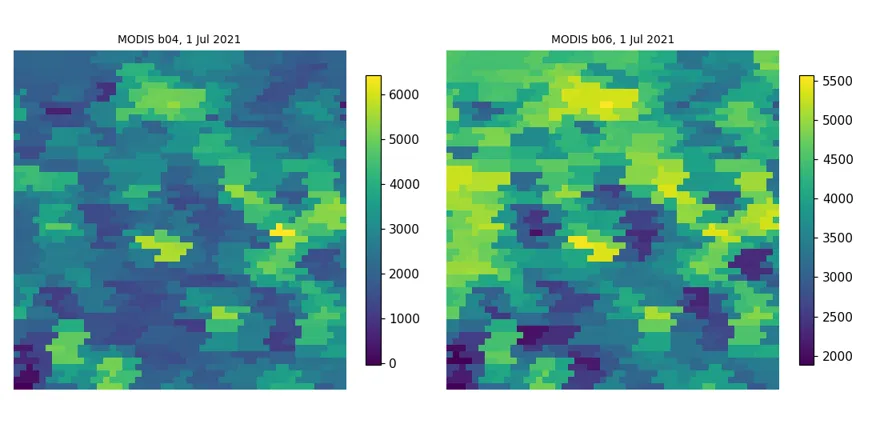
Calculate the mean NDSI (Normalized Difference Snow Index) for the Tibetan Plateau on July 1, 2021, using MODIS surface reflectance bands (sur_refl_b04 and sur_refl_b06). Round the result to three decimal places.

## Options

- A. -0.198
- B. -0.203
- C. -0.209
- D. -0.215

## Inputs

The input files (2 files) are in `/app/benchmark/data/question129/`. The working directory is `/app`, so a path written as `benchmark/data/question129` in the question points there.

## Deliverable

Write `/logs/artifacts/answer.json` containing one JSON object:

```
{"answer": "<option letter>", "value": <number>}
```

- `answer`: the letter of your chosen option (A, B, C, D).
- `value`: the number you computed that decides the choice, in the units the options use. Give percentages as percent numbers (28.07 for 28.07%) and changes or trends as signed numbers (negative for a decrease).

## Acceptance

- `answer` must be the correct option.
- `value` must be closer to the figure stated in the correct option than to the figure in any other option.

Earth-Bench natively gives the agent a set of Earth-observation tools; here you compute with Python instead. Python 3.12 with NumPy, SciPy, pandas, rasterio (Python API), pyproj, Matplotlib, statsmodels and ruptures is installed. There is no GDAL command-line tool and no network access.- Inputs
- Tibetan Plateau_sur_refl_b04_2021-07-01.tif, Tibetan Plateau_sur_refl_b06_2021-07-01.tif
- Expected answer
- B (-0.203)
- How it is checked
- By code; the option letter must equal the key, and the value given must be nearer the keyed option than any other.
Explore evaluations
- Spatial Intelligence IndexAgent tasks, vision, guided workflows and geospatial knowledge, per model
- Spatial Agent IndexEarth-Bench V2, GeoBenchX and GS-QA2; Text + vision adds Vision agents
- GeoBenchXGeoBenchX asks for maps, numbers and lists from country-level and city-level geospatial data.
- GS-QA2GS-QA2 asks questions about places and terrain in the United States over OpenStreetMap vector layers and ASTER elevation data: nearest features, directions, distances, counts, elevations, slopes and features that meet terrain conditions.
- GeoAgentBenchGeoAgentBench gives an agent a geospatial question and the data to answer it, and expects the result files and a map.
- GeoAnalystBenchGeoAnalystBench collects GIS analyst workflows (suitability analysis, interpolation, hot spots, network and overlay work).
- OGD4AllOGD4All asks everyday questions about the City of Zurich's open government data: trees, buildings, transport, schools and more, from about 430 public datasets in GeoPackage and CSV form.
- GeoNatureAgentGeoNatureAgent asks for figures from environmental rasters over Spanish provinces and regions: here, the share of land suitable for CO₂ storage, by province, with follow-up questions that compare, rank or break the figures down.
- MultiGlobeQAMultiGlobeQA asks spatial questions about places all over the world: what lies within, next to or nearest to what, how far apart things are, and how many there are.
- GeoAgentEvalGeoAgentEval tests whether an agent can build, audit and repair spatial data in a PostGIS database, and decline honestly when a request cannot be done: flood zones, wards, routes, coordinate systems and stale records in one made-up town.
- OpenEarthAgent MapsOpenEarthAgent Maps asks questions about real places over OpenStreetMap: which features lie beyond a distance or a travel time from the nearest school, hospital or fire station, which pairs are closest, and averages over them.
- OpenEarthAgent Sentinel-2OpenEarthAgent Sentinel-2 asks how a place changed between two dates: vegetation loss and gain, urban growth, or burn severity.
- GS-QA2 FullGS-QA2 Full asks the same questions as GS-QA2, over the same OpenStreetMap vector layers and ASTER elevation data, but runs every question that passed our admission checks, not a balanced sample, across almost all of the release's question templates.
- Place and coordinate tasksTasks we built, in four families: find a place's coordinates from its name, name the place at a coordinate, measure the distance between two places, and give the direction from one to another.
- InSAR Regional Snow MappingOur first tasks on synthetic aperture radar (SAR): 64 Sentinel-1 interferogram windows from January 2021 to March 2023 over the Trentino Alps, with phase, coherence and displacement layers, two weather layers and modelled snow depth.
- GeoChronoGeoChrono asks about long-term change in a place seen over many years: what the land cover is, whether an area grew or shrank, when an object appeared and how things changed in order.
- GeoChrono larger setThe larger GeoChrono set is 1,000 of the 17,688 ChronoBench questions that have a keyed answer, 250 for each of GeoChrono's four levels, chosen with a fixed seed.
- BigEarthNet.txtBigEarthNet.txt asks about 1.2 km image patches over Europe: which land cover is present, how much, how many patches of it, what is next to what, and the country, season and climate zone.
- DVL-BenchDVL-Bench asks about change in a place seen over several years: which kinds of ground cover changed, which change was least, whether vegetation or built-up surface grew or shrank, when building expansion stopped, in which period the most change happened, and by how much.
- Geospatial knowledgeClosed-book multiple-choice questions on geospatial knowledge
- VisionQuestions answered from images
- Earth-Bench V2 imagesEarth-Bench V2 images are the Earth-Bench V2 questions that need the model to look at RGB satellite pictures: multiple choice on counting objects or scene types, ranking pictures by count or area, and comparing what changed.
- ThinkGeo imagesThinkGeo asks for one number about aerial and satellite images: a count, an area, a distance or a heading, accepted within a range.
- Vision agentsAgents that look at aerial images and use code