
Object detection · Open source
A tent and building detector, trained on labels an LLM drafted.
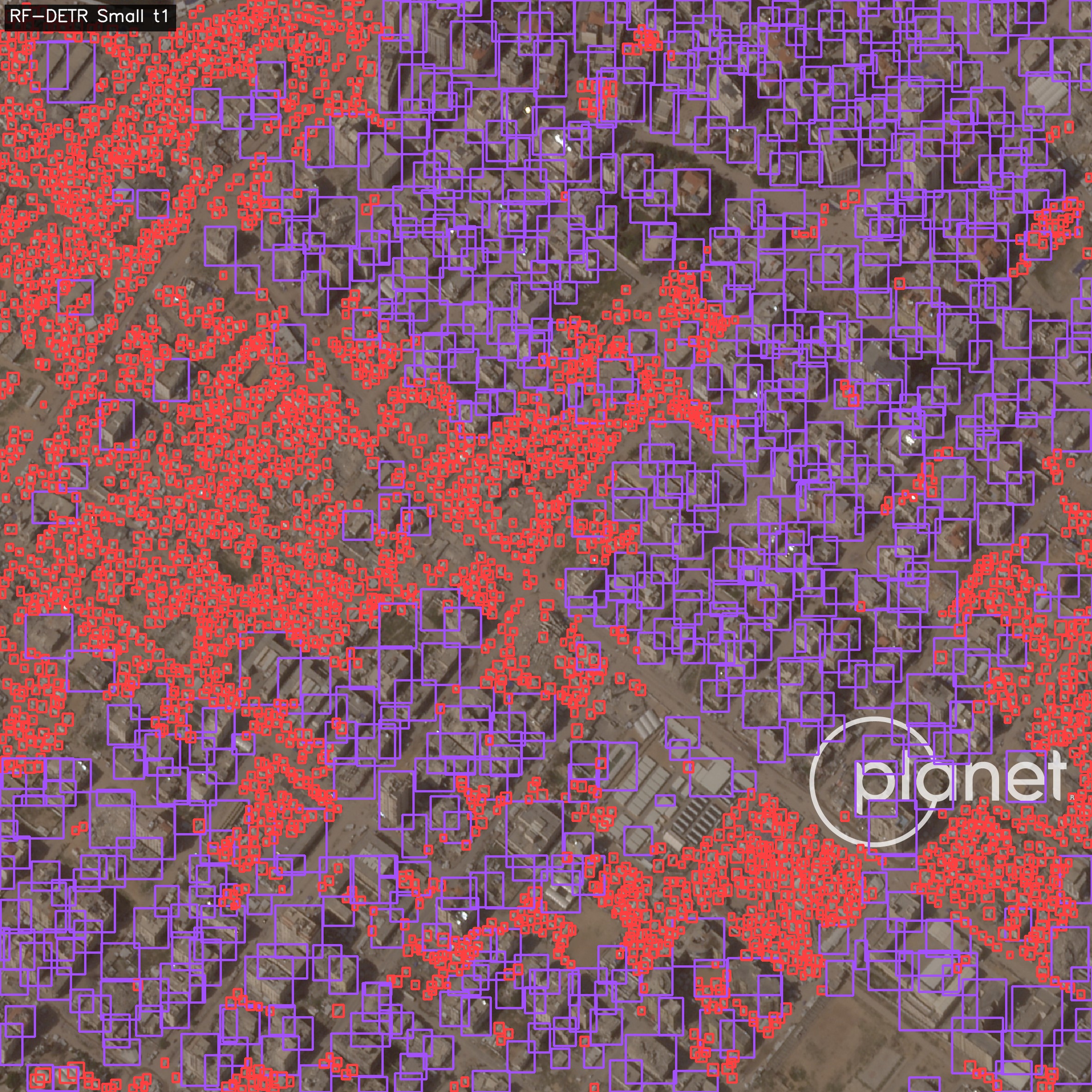
An image-capable LLM drafted the bounding boxes. We reviewed them in Roboflow and trained RF-DETR Small on 45 image crops: 3,421 tent boxes and 833 building boxes from Gaza and Sudan. The final checkpoint scored 57.8% tent AP50 and 27.5% building AP50 against our own AI-reviewed references, not independent ground truth. It is a capability test, released so you can run it on your own imagery.
What we built
Labelling thousands of small objects by hand is the slow part of training a detector. We tried a shortcut: upload clean image crops to an image-capable LLM, ask for boxes in a fixed coordinate format, draw them back onto the image and review them in Roboflow. Only reviewed boxes went into training.
We started with tents in Gaza, added a building class so the model could tell roofs from tents, then added a small set of Sudan crops with buildings only. The tent candidates began from TentNetFA prediction markers, so the tent labels were not an independent reading of the scene.
What the model did
The first tent-only RF-DETR Nano, trained on 36 Gaza crops, reported AP50 of 56.1% on four reserved Gaza crops. It also labelled ordinary roofs in Morocco as tents. An earlier joint RF-DETR Small with both classes reported 60.8% tent and 74.7% building AP50 on the same four crops, with only 19 building references.
The final Gaza and Sudan model reported 57.8% tent and 27.5% building AP50 on seven mixed crops. The building test had changed from 19 references to 111, so the drop is not a measured regression. We did not keep both checkpoints evaluated on the same scenes, so we cannot say which is better.
Tiling mattered. On one 2,064 × 2,064 Sudan area, a single whole-area pass returned 7 building candidates; the same model on stitched 512-pixel tiles returned 700. Those are candidate counts, not verified buildings, and the area was inside the training geography.
What you can use today
- The code (MIT): a converter that turns reviewed LLM boxes into COCO annotations and rejects bad geometry, unknown classes and unfinished reviews, plus local and hosted inference scripts.
- The weights (CC BY 4.0): the final RF-DETR Small checkpoint, 127 MB, in the v0.1.0 release with a SHA-256 to check before loading. It ran locally on Python 3.12 with rfdetr 1.11.2.
- The dataset and hosted model (CC BY 4.0): the 45 reviewed image crops and the trained model are public on Roboflow Universe. You can fork the dataset or try the model in the browser.
- The method: a prompt you can adapt and the review checks we used.
Limits
- Scores measure agreement with AI-reviewed pseudo-labels. No human ground truth was used.
- The model does not give reliable counts, footprints or occupancy, and has not been tested on aerial imagery.
- Turkey is the only scene outside training, and it has no exhaustive reference. Sudan tent recall cannot be measured: we had no accepted Sudan tent positives.
- The release does not reproduce the training run or the tiled-scene workflow.
Read the full write-up for the data, the settings and the inference checks. If you are exploring detection on your own aerial or satellite imagery, tell us about the work.
Start here
Tell us about your project.
Tell us how the work is done today, which data and software it uses, and what your team needs.