Benchmark · Arena
Which AI model is best at geospatial work?
Geospatial Agent Benchmarks runs AI models on GIS and Earth observation tasks and checks every answer with code. Same tasks, same checks, for every model.
What it measures
Tasks on maps, spatial data and satellite imagery, run in isolated sandboxes.
Eight public benchmarks sit under one protocol. They roll up into one headline score: the Geospatial Intelligence Index.
Agent tasks count most. Vision, guided workflows and geospatial knowledge make up the rest. Models without image input are still ranked, in the Text only view.
How each answer is checked
An attempt passes only if every required check passes. A plausible-looking answer is not enough.
Code checks values, coordinate reference systems, units, geometry, rasters and output files against the source data.
Where the output is a map, a judge grades it against a yes-or-no checklist. The same judge reads every passing trace for shortcuts. A flagged attempt scores 0.
We audited the tasks too. Every source benchmark had broken ones, and each exclusion is listed publicly with its reason.
The top five today
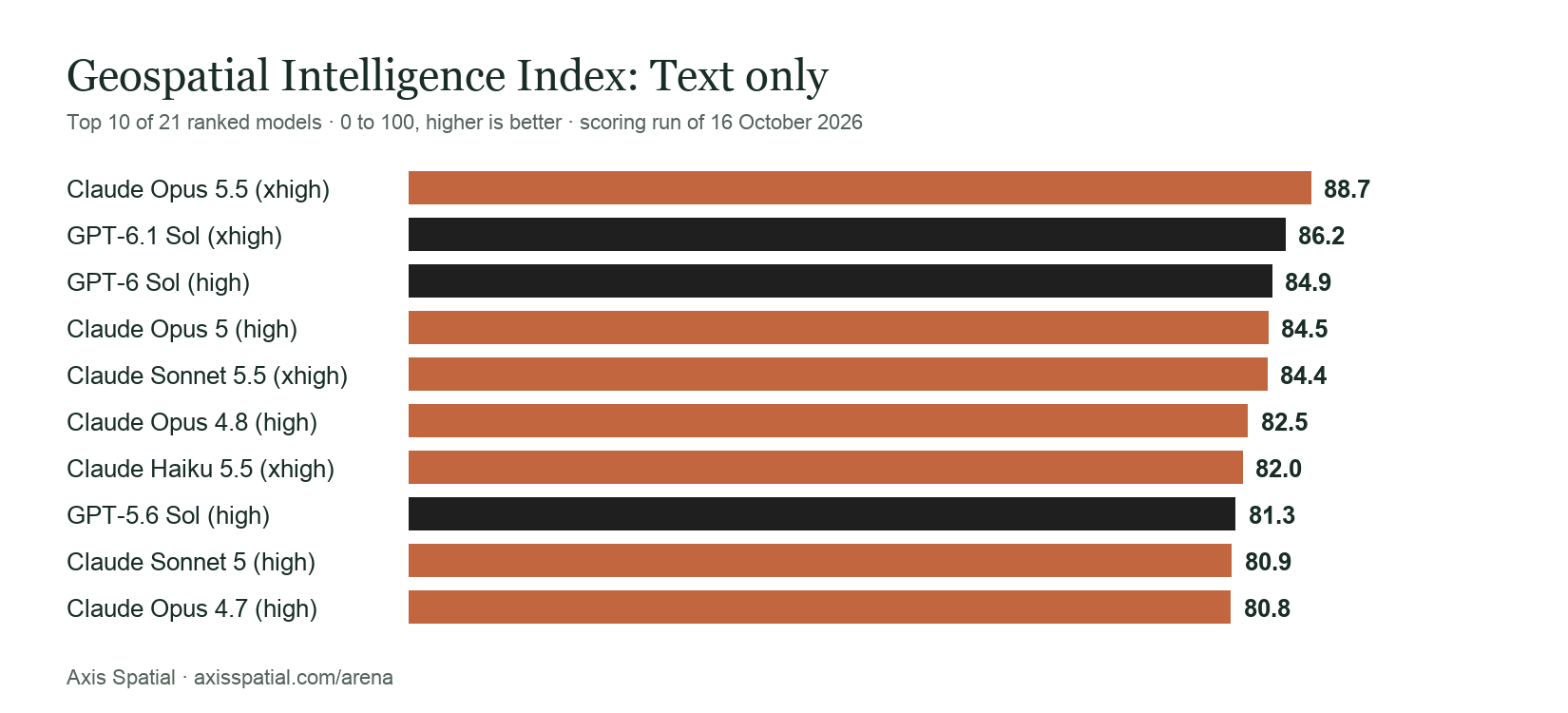
Text only view, top 5 of 21 ranked models, scoring run of 16 October 2026:
- Claude Opus 5.5 (xhigh): 88.7
- GPT-6.1 Sol (xhigh): 86.2
- GPT-6 Sol (high): 84.9
- Claude Opus 5 (high): 84.5
- Claude Sonnet 5.5 (xhigh): 84.4
The top is close. Differences under about 3 points are within noise, so read the order as observed performance, not a precise ranking.
Score and cost, side by side
Cost per task varies far more than score.
Claude Haiku 5.5 (xhigh) scores 82.0 at $0.017 per agent task, about a fifteenth of the leader’s cost.
Open-weights models trail by about 10 points. The best, DeepSeek V4 Pro (max), scores 79.0.
How far to trust it
Every task comes from a published benchmark, so models may have seen some of them in training.
Scores are first attempts, under our setup, not production. The method is public and versioned, and scoring never changes without a new version.
What comes next
The basics are saturated. No ranked model reaches 90 on agent tasks or vision.
Next: finish the models not yet ranked, add harder agent tasks, add more vision work, and publish a release paper.
For model developers and teams
Pick a model by score and cost per task, not by general leaderboards.
Suggest a model, report a task you think is broken, or offer tasks from your own work. Get in touch.
Start here
Tell us about your project.
Tell us how the work is done today, which data and software it uses, and what your team needs.